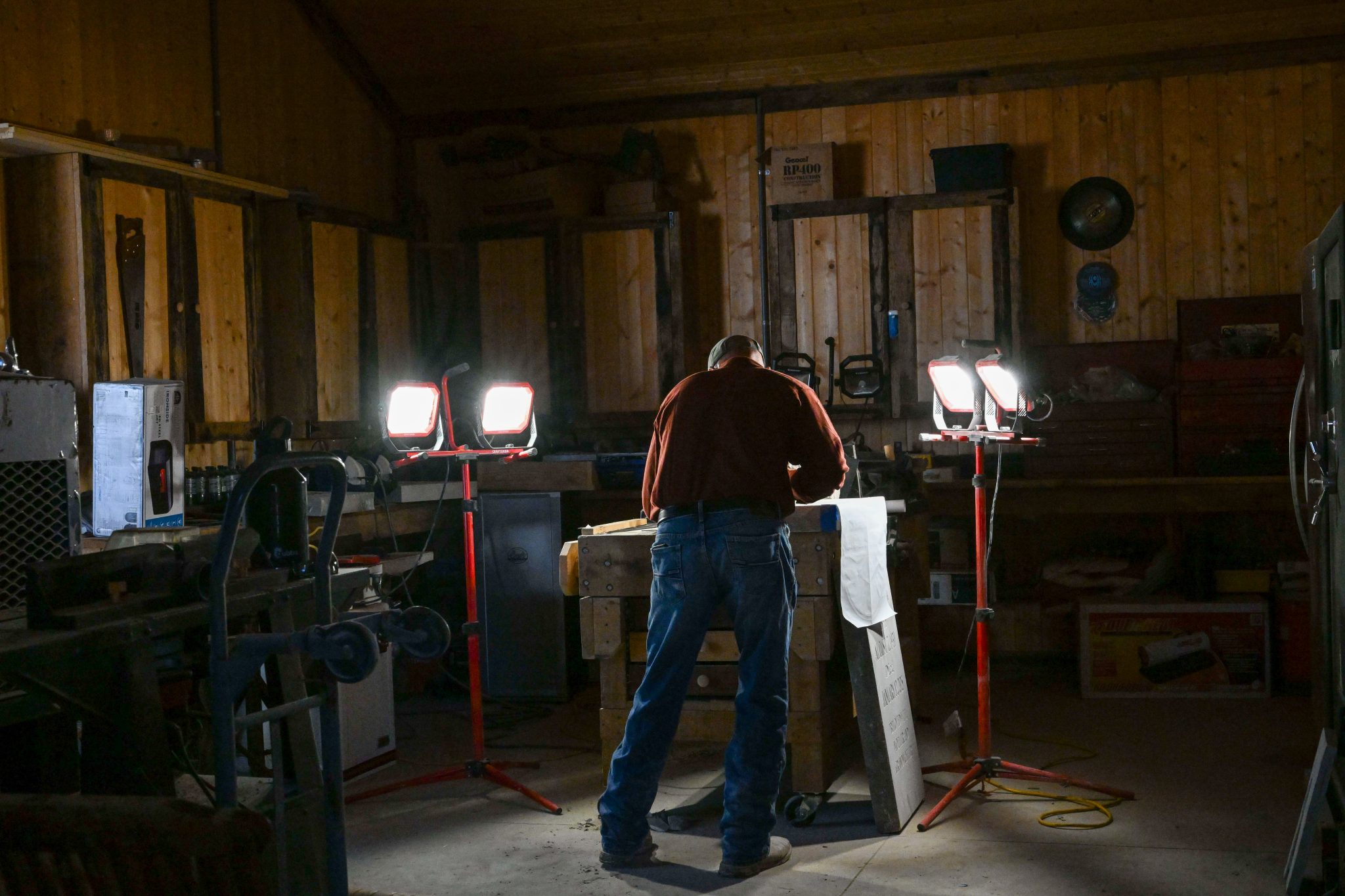
In the summer of 2006, Stuart Joynt IV’s wife asked him to build a stone wall around her garden. It was bad.
Determined to fix his garden wall, Stuart spent hours learning dry stone masonry on YouTube and eventually entered a competition where he met a Scottish master stone mason who said he had a knack for the craft, but needed a bit of work.
That master took Stuart under his wing and what began as a backyard mistake became a life’s work, one that is leaving a lasting mark on the Bluegrass and beyond.
Stuart is now one of around 15 master dry stone masons in the United States, craftsmen preserving an ancient tradition while building structures future generations will inherit.
Living in Winchester, Stuart is perfectly situated to pursue his craft. Stone fences trace the Bluegrass like veins, winding through horse farms and following country roads. They seem to rise from the earth itself, as much a part of the landscape as the rolling hills. Yet every stone was placed by hand, balanced against another without mortar, by craftsmen whose work has outlived them for generations.
“I’m a craftsman, that’s what I do,” Stuart said. “I am not an artisan. I like to take my time to learn the craft, not learn design, because the most fun is in the craft, not in the design.”
Stuart builds and restores walls, chisels stone, and creates and restores gravestones. His work has taken him around the world, including Grand Teton National Park in Wyoming and building fences in Ireland, the country that originated Kentucky-style stone fences.
Working alongside his son, Stuart Joynt V, and Todd Keen, a former contractor who brings cost estimation and logistics expertise, Stuart studies the fingerprints of masons long gone. Stuart and Todd are the yin and yang that makes the business run.
“I really admire the artistic ability of Stuart,” Todd said.
For Stuart, craftsmanship is practical. “I think about production, how long will this take me,” he said. But the reward comes when the final stone is placed, when he can step back and admire something hundreds of thousands may pass each year, knowing it could endure for centuries.
“More than 250,000 people walk by the wall I built at the Grand Tetons every year and take photos,” he said. “That work will be there for over a hundred years. That work is in a piece of all of their memories and will be for generations to come.”
